Agentic AI in 2026: What It Is, Real Business Use Cases, and How to Get Started
Introduction
For the last two years, most businesses met AI through a chat window: you ask a question, it writes an answer. Useful, but you still had to copy that answer into your CRM, raise the ticket, send the email and update the spreadsheet yourself.
In 2026 that is changing fast. The most searched phrase in business technology right now is agentic AI — AI that does not just reply, but actually gets the work done. It reads the request, plans the steps, uses your software tools, checks its own output and hands the result back for approval.
In this article, we explain what agentic AI is in plain language, how it differs from the chatbots and generative AI tools you already know, where it is delivering real value for Indian businesses, and how you can launch your first AI agent safely in a few weeks.
What is agentic AI?
Agentic AI is a type of artificial intelligence that can pursue a goal on its own — planning the steps, using tools and data, taking actions and checking the results — with limited human supervision.
A normal AI chatbot answers a question. An AI agent completes a task.
For example, if a customer writes "I was charged twice for my order":
- A chatbot explains your refund policy.
- An AI agent looks up the order, confirms the duplicate payment in your payment gateway, starts the refund, updates the ticket, and sends the customer a confirmation — asking a human for approval only if the amount is above a set limit.
Agentic AI vs generative AI vs chatbots
| Rule-based chatbot / RPA | Generative AI (copilots) | Agentic AI | |
|---|---|---|---|
| What it does | Follows fixed scripts | Writes and summarises content | Plans and completes multi-step tasks |
| Handles new situations | No | Partly | Yes, within guardrails |
| Uses your tools (CRM, ERP, email) | Only pre-coded steps | Rarely | Yes — calls APIs and apps directly |
| Who does the final action | The bot, rigidly | The human | The agent, with human approval where needed |
| Best for | Repetitive, unchanging steps | Drafting, research, Q&A | End-to-end workflows |
In short: generative AI is the brain that understands and writes; agentic AI adds hands (tools), a to-do list (planning) and a conscience check (verification and approval).
Why agentic AI is trending in 2026
The interest is not just hype. Analyst firm Gartner has forecast that by the end of 2026, around 40% of enterprise applications will include task-specific AI agents, compared with less than 5% in 2025. Gartner also projects that agentic AI could drive roughly 30% of enterprise application software revenue by 2035 — more than $450 billion.
Three things made this possible:
- Better reasoning models. Today's large language models can break a goal into steps and recover from mistakes far more reliably than earlier versions.
- Standard ways to connect tools. Open standards such as the Model Context Protocol (MCP) make it much easier to plug an agent into business systems like CRMs, databases, ticketing tools and email.
- Pressure on costs and speed. Businesses want to serve more customers without proportionally growing headcount — and agents handle the repetitive middle of a process at any hour.
How an AI agent works: the 4-step loop
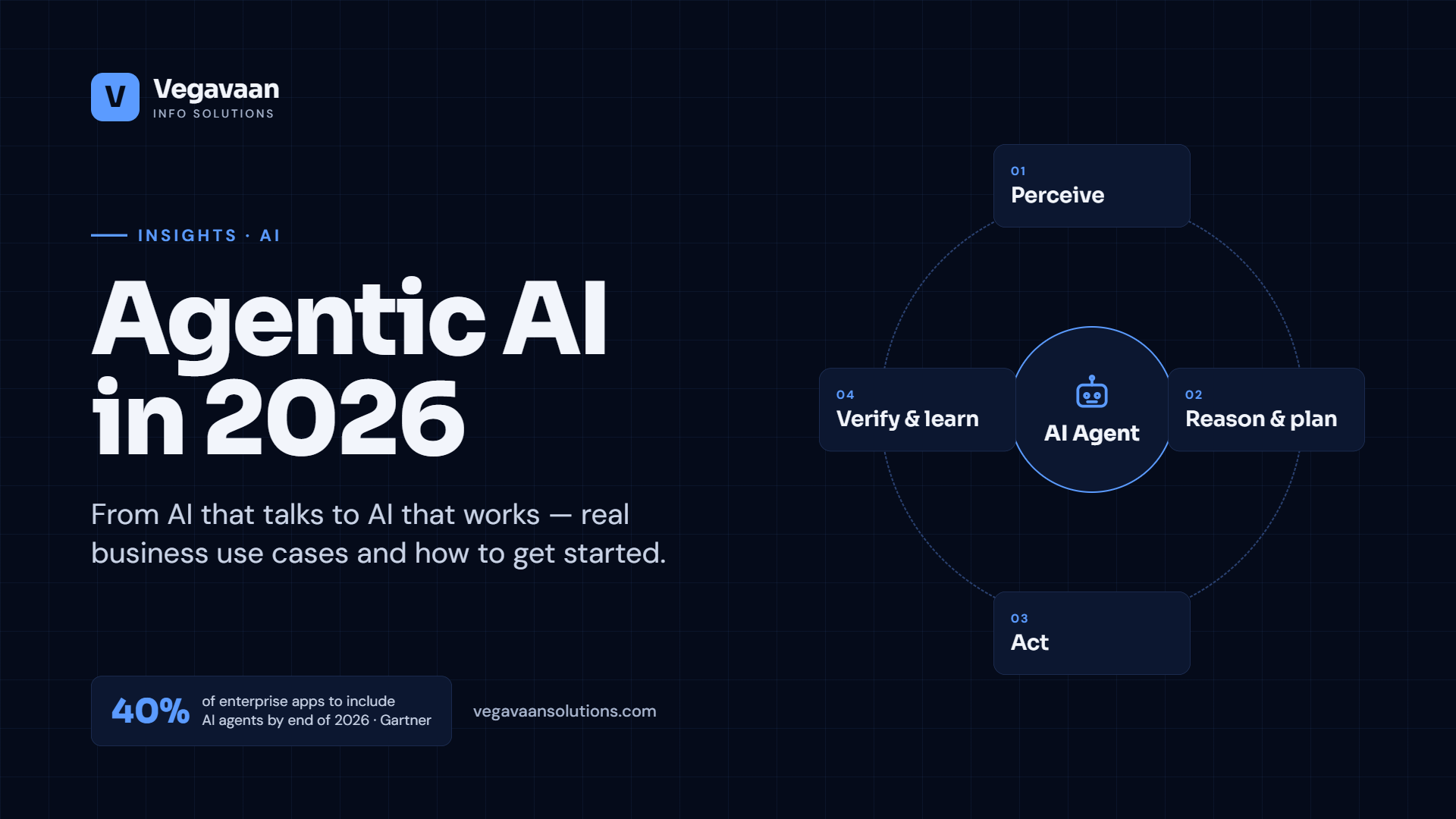
Every well-built AI agent follows a simple loop:
- Perceive — It receives a goal or event: an email, a form, a WhatsApp message, an uploaded invoice, an alert.
- Reason and plan — It decides what needs to happen and in what order, using your business rules and knowledge base (often through RAG — retrieval-augmented generation — so answers are grounded in your own documents).
- Act — It uses approved tools: queries a database, updates a CRM record, books a slot, drafts a reply, raises a ticket.
- Verify and learn — It checks the result, asks a human to approve sensitive steps, logs everything, and improves from feedback.
Real business use cases of agentic AI
Here is where we see agents delivering measurable value today, especially for Indian businesses:
- Customer support: 24/7 agents on website chat, WhatsApp and phone that resolve order status, refunds, bookings and complaints — in English, Hindi and regional languages — and escalate only complex cases.
- Finance and accounts: Reading invoices and purchase orders with Document AI, matching them against the ERP, flagging mismatches and preparing entries for approval.
- Sales and lead management: Qualifying inbound leads, enriching them with company data, updating the CRM, and booking meetings for the sales team.
- HR and recruitment: Screening resumes against the job description, scheduling interviews and answering employee policy questions.
- IT operations: Monitoring alerts, diagnosing common incidents, restarting services or opening tickets with full context attached.
- Banking and fintech: KYC document checks, fraud and anomaly flagging, and loan application pre-processing.
- Legal and compliance: Reviewing contracts against a standard playbook and highlighting risky clauses for a lawyer.
- Healthcare: Appointment booking and reminder voice agents, and summarising clinical notes for doctors.
- Education: AI tutors that answer student doubts, generate practice quizzes and track progress.
- Government and public sector: Citizen service assistants and digitising paper records with AI-powered OCR.
Risks and how to manage them
An agent that can act needs more care than a chatbot that only talks. The good news is that the risks are well understood:
- Wrong or made-up answers: Ground the agent in your own data with RAG and require sources for every answer.
- Too much access: Give agents the minimum permissions they need — read-only by default, write access only where justified.
- High-impact actions: Keep a human in the loop for payments, refunds above a limit, legal communication and anything irreversible.
- Data privacy: Keep personal data protected and processed in line with India's Digital Personal Data Protection (DPDP) Act, 2023, and your industry regulations.
- Lack of visibility: Log every step the agent takes so you can audit, debug and explain its decisions.
- Runaway costs: Set usage limits and track cost per completed task, not just per API call.
This is why AI governance is trending right alongside agentic AI — the two go together.
How to get started: a simple 4-step plan
You do not need a big AI budget or a data science team to begin.
- Pick one painful, repetitive workflow. Look for tasks that are high-volume, rule-heavy and touch two or more systems — for example, invoice processing or first-level support tickets.
- Define success in numbers. Time saved per task, cases resolved without escalation, error rate, response time.
- Build a focused proof of concept (2–4 weeks). Connect the agent to real (or sandbox) data and tools, add guardrails and human approval, and test it with a small group of users.
- Measure, then scale. If the numbers work, roll it out, add more tools and workflows, and put monitoring and governance in place.
The technology behind an AI agent (in brief)
A typical production agent combines:
- A large language model for reasoning and language
- RAG and a vector database to search your documents and data
- Tool connectors / APIs (often via MCP) for your CRM, ERP, email, WhatsApp and databases
- An orchestration layer that manages planning, memory, retries and multi-agent handoffs
- Guardrails, approvals and observability for safety, audit logs and cost tracking
- Secure cloud hosting on platforms such as AWS or Azure
How Vegavaan can help
At Vegavaan Info Solutions, we help businesses move from AI experiments to AI that delivers results. Our team designs and builds agentic AI solutions, RAG knowledge assistants, AI chatbots and voice agents and AI workflow automation — with security, governance and human approval built in from day one.
We can take you from idea to a working agentic AI proof of concept on your own data in 2–4 weeks.
👉 Book a free AI discovery session and we will map your highest-value use cases and share a PoC plan, timeline and estimate.
Frequently asked questions
What is agentic AI in simple words?
Agentic AI is AI that can take a goal, plan the steps, use software tools and complete the task on its own, asking a human for approval when needed — instead of only answering questions.
What is the difference between generative AI and agentic AI?
Generative AI creates content such as text, images or code in response to a prompt. Agentic AI uses generative AI as its "brain" but adds planning, tool use and actions, so it can complete multi-step business tasks end to end.
Is agentic AI safe for business use?
Yes, when it is built with the right guardrails: limited permissions, human approval for high-impact actions, grounding in your own data, full activity logs and compliance with data-protection laws like India's DPDP Act.
How much does it cost to build an AI agent?
It depends on the number of workflows, integrations and users. Most businesses start with a single-workflow proof of concept, which keeps the initial investment small and proves ROI before scaling.
Which business processes should I automate first with AI agents?
Start with high-volume, repetitive processes that involve multiple systems — customer support queries, invoice and document processing, lead qualification and IT ticket handling are common first choices.
Conclusion
Agentic AI is the next big step after chatbots and generative AI: from AI that talks to AI that works. Businesses that start with one well-chosen workflow today will build the experience, data and confidence to lead tomorrow.
Ready to build your first AI agent? Talk to a Vegavaan AI expert today.
Source for statistics: Gartner press release (August 2025).