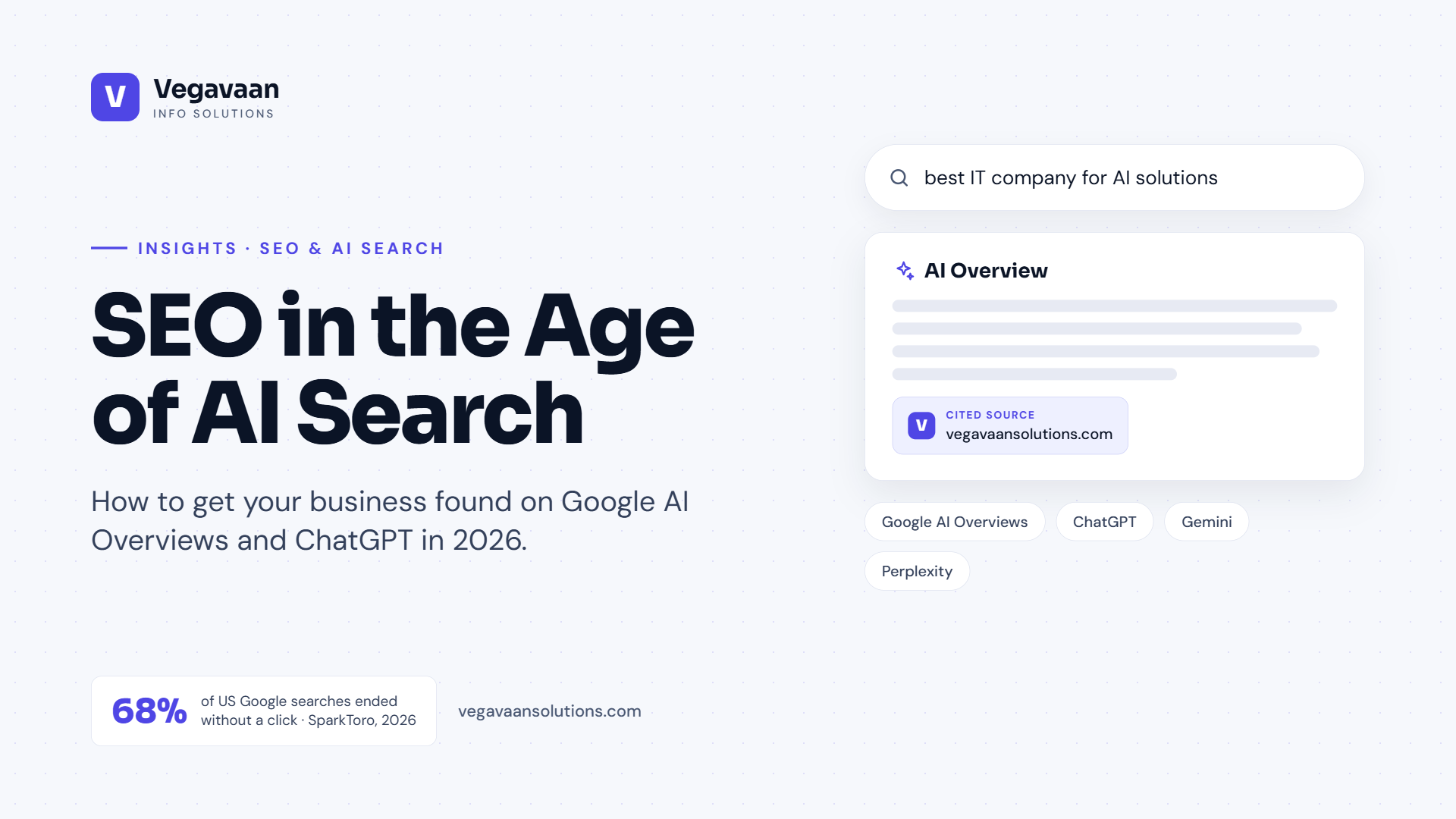
SEO in the Age of AI Search: How to Get Your Business Found on Google AI Overviews and ChatGPT in 2026
Introduction
Search is changing faster than at any time since Google began. Today, when someone types a question into Google, they often get an AI-written answer at the top of the page — before any website link. Millions more skip Google entirely and ask ChatGPT, Gemini, Perplexity or Claude.
For businesses, this raises an urgent question: if people get their answer without clicking, how do they find you?
The answer is a new discipline called Generative Engine Optimization (GEO) — also known as AI search optimization or Answer Engine Optimization (AEO). In this guide, we explain what it is, why it matters in 2026, and a practical step-by-step plan to make your website the source that AI tools trust and cite.
What is Generative Engine Optimization (GEO)?
Generative Engine Optimization (GEO) is the practice of optimising your content so that AI-powered search tools — such as Google AI Overviews, Google AI Mode, ChatGPT, Gemini and Perplexity — understand it, trust it and cite it in their answers.
Traditional SEO aims to rank your page in a list of ten blue links. GEO aims to make your brand part of the answer itself, usually as a cited source or a recommended business.
SEO vs GEO: what is the difference?
| Traditional SEO | GEO / AI search optimization | |
|---|---|---|
| Goal | Rank high in search results | Be cited or recommended in AI answers |
| Where it shows | Google and Bing result pages | AI Overviews, AI Mode, ChatGPT, Gemini, Perplexity |
| What wins | Keywords, backlinks, page speed | Clear answers, expertise, facts, brand mentions and structured content |
| Success metric | Rankings and clicks | Citations, brand visibility and qualified leads |
The good news: GEO does not replace SEO. A technically strong, well-ranked website is still the foundation AI tools draw from. GEO builds on top of it.
Why AI search matters for your business in 2026
The data from early 2026 shows how quickly search behaviour is shifting (figures are from US studies, which typically lead global trends):
- Google AI Overviews appeared in about 43% of US searches in May 2026, up from roughly 15% a year earlier, according to Similarweb.
- SparkToro found that 68% of US Google searches ended without a click to any website between January and April 2026.
- A 2026 field experiment found that organic clicks fell by about 38% when an AI Overview appeared on the page.
In simple words: fewer people click through to websites, and the businesses that do get seen are the ones AI chooses to mention. The upside is that visitors who arrive after reading an AI answer are often better informed and closer to making a decision.
How AI search engines choose which sources to cite
AI tools do not publish their exact rules, but across platforms they consistently favour content that is:
- Directly helpful — answers a specific question clearly and early on the page.
- Trustworthy — written by a real business or expert, with author details, credentials and up-to-date information.
- Easy to extract — uses clear headings, short paragraphs, lists, tables and FAQs.
- Backed by facts — includes data, examples and sources rather than vague claims.
- Consistent across the web — the brand is mentioned in the same way on its website, Google Business Profile, directories, reviews and industry publications.
- Technically accessible — fast, mobile-friendly and crawlable by search engines and AI bots.
The 10-step GEO checklist for 2026
- Answer the question first. Start each article or service page with a clear 40–60 word answer to the main question, then go deeper.
- Write for real questions. Use tools like Google's "People also ask", customer emails and sales calls to find the exact questions buyers ask — then answer them one by one.
- Add FAQ sections to key pages, with short, direct answers.
- Use structured data (schema markup) such as Organization, LocalBusiness, Article, FAQ, Product and Service so machines understand your content.
- Show expertise (E-E-A-T). Add author bios, real project examples, case studies, certifications and client results.
- Include original facts and numbers. Pricing ranges, timelines, statistics and your own data make content more quotable.
- Keep content fresh. Update important pages regularly and show the "last updated" date.
- Build brand mentions, not just backlinks. Get listed on trusted directories, industry sites, news articles, podcasts and review platforms.
- Optimise your Google Business Profile with accurate details, services, photos and regular reviews — essential for local AI recommendations.
- Fix technical SEO. Fast loading, mobile-friendly design, clean site structure, an XML sitemap, and make sure your robots.txt does not accidentally block search and AI crawlers you want to reach.
How to measure success in AI search
Because AI answers often do not produce a click, measure more than just traffic:
- AI visibility: Regularly ask ChatGPT, Gemini, Perplexity and Google AI Mode the questions your customers ask — note whether your brand is mentioned or cited.
- Referral traffic from AI tools: Track visits from chatgpt.com, perplexity.ai, gemini.google.com and similar sources in Google Analytics.
- Branded search growth: More people searching your company name is a strong sign AI answers are mentioning you.
- Lead quality: Track enquiries and conversion rates, not just sessions.
- Search Console impressions: Rising impressions with flat clicks often means you are visible in AI-influenced results.
Common mistakes to avoid
- Publishing large volumes of generic, AI-generated articles with no original insight
- Hiding key information inside images, PDFs or complex scripts that crawlers cannot read
- Inconsistent business names, addresses and phone numbers across the web
- Ignoring reviews and your Google Business Profile
- Measuring success only by organic clicks
How Vegavaan can help
At Vegavaan Info Solutions, we combine technical SEO, content strategy and AI expertise to help your business stay visible as search changes. Our team offers:
- SEO and AI search optimization — technical audits, schema markup, on-page optimisation and GEO strategy
- Content marketing — expert-led blogs, FAQs and case studies written to be cited
- Fast, SEO-ready websites built for both people and AI crawlers
- Digital marketing to grow brand visibility across Google, Meta and LinkedIn
👉 Book a free AI search visibility audit and we will show you how your business currently appears in Google AI Overviews and ChatGPT — and what to fix first.
Frequently asked questions
What is GEO in digital marketing?
GEO, or Generative Engine Optimization, is the process of optimising your website and online presence so AI search tools like Google AI Overviews, ChatGPT, Gemini and Perplexity mention or cite your business in their answers.
Is SEO dead because of AI search?
No. AI search tools still rely heavily on well-structured, trustworthy, high-ranking web pages as their sources. SEO remains the foundation; GEO adds techniques that make your content easier for AI to understand and quote.
How do I get my website cited in Google AI Overviews?
Publish clear, expert answers to specific questions, use headings, lists and FAQs, add schema markup, keep information up to date, and build trust through author details, reviews and mentions on other reputable sites.
Can my business appear in ChatGPT answers?
Yes. ChatGPT and similar tools draw on web content and brand mentions. A strong website, consistent business listings, positive reviews and coverage on trusted sites all increase the chance that your business is mentioned.
How long does GEO take to show results?
Technical fixes and schema can be done in weeks, while content and brand authority build over months. Most businesses see early signs — such as rising impressions and AI mentions — within two to three months of consistent work.
Conclusion
Search is moving from "ten blue links" to AI-generated answers. The businesses that win will be the ones AI trusts enough to quote. Start with strong SEO foundations, answer your customers' real questions clearly, and build credibility across the web.
Want to know how visible your business is in AI search today? Talk to a Vegavaan SEO expert.
Sources for statistics: Similarweb data as reported by Pasquale Pillitteri; SparkToro and Agarwal & Sen data as reported by TechWyse.